The Canadian tech landscape in 2026 is no longer defined just by the “Big Three” hubs of Toronto, Vancouver, and Montreal. From the burgeoning AI corridor in Edmonton—anchored by the University of Alberta—to the fintech surge in Calgary and the “Ocean-Tech” evolution at Dalhousie University in Halifax, the nation is undergoing a digital renaissance. However, this rapid expansion has exposed a widening fissure: the “Skills Gap.” While Canadian universities remain world-class, the pace of industry innovation is currently outstripping traditional academic cycles.
This disconnect has forced a radical re-evaluation of how Computer Science (CS) is taught at premier institutions like McGill University and the University of British Columbia (UBC). We are seeing a shift from purely theoretical frameworks to “Applied Computational Intelligence.” Today’s recruiters at Shopify, OpenText, and Canadian startups are no longer just looking for a degree; they are looking for candidates who can navigate decentralized systems, ethical AI deployment, and green coding practices.
For many students, keeping pace with these shifting departmental requirements is a massive undertaking. As curricula become more rigorous to meet industry standards, seeking professional Computer Science Assignment Help in Canada has become a strategic way for learners to master complex specialized modules—such as quantum-safe cryptography or advanced neural networks—that were barely mentioned in textbooks three years ago.
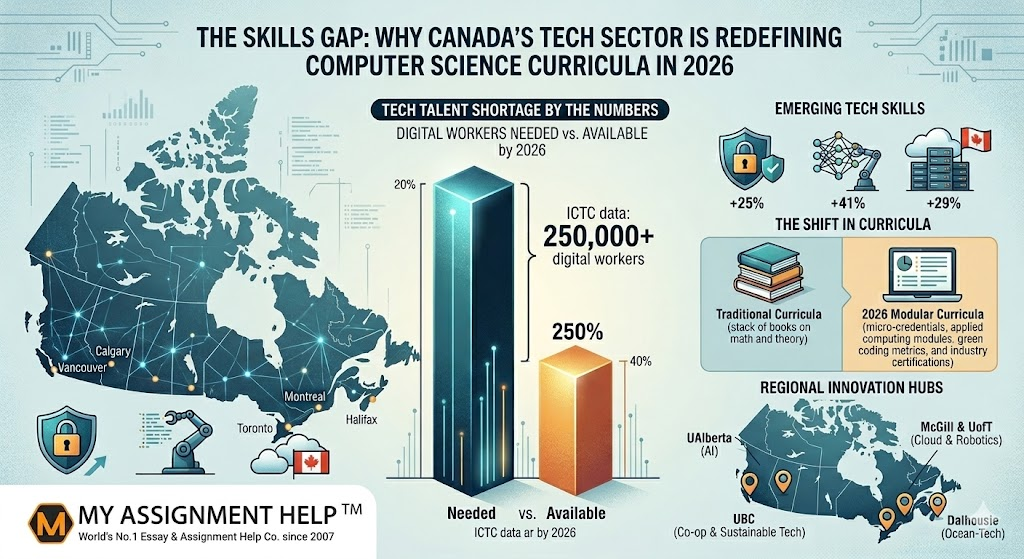
The 2026 Tech Talent Shortage by the Numbers
According to recent data from the Information and Communications Technology Council (ICTC), Canada requires over 250,000 additional digital workers by the end of 2026. The most significant shortages are found in:
- Cybersecurity & Resilience: As Canadian infrastructure digitizes, the demand for SOC analysts has tripled.
- AI & Machine Learning Engineering: Beyond basic coding, the industry requires “Prompt Engineers” and “AI Ethicists.”
- Cloud Architecture: Expertise in Azure and AWS (Canadian regions) is now a non-negotiable core skill.
Why Traditional Curricula are Shifting
Historically, a CS degree focused heavily on the mathematical foundations of computing. While these remain vital, the 2026 Canadian tech sector demands Information Gain—the ability to apply knowledge to solve unique, localized problems. This has led to the “Modularization” of degrees. For example, UBC’s renowned Co-op program and McGill’s Techfair initiatives are increasingly offering micro-credentials within a standard degree to keep students updated on real-time industry shifts.
However, this transition phase is difficult for the current cohort. Balancing a part-time internship in a competitive economy while mastering a curriculum that changes every semester is a high-pressure act. It is not uncommon for students across provinces to seek out reliable platforms to do my assignment as a means to manage their heavy workload, ensuring they don’t fall behind in their foundational GPA while they focus on high-level industry certifications.
See also: Bulk Clear Acrylic Keychains on Vograce: Cost & Benefits
Key Takeaways for 2026
- Industry Integration: Institutions like Waterloo and SFU are moving toward “Co-op 2.0,” where industry leaders influence final-year project requirements.
- Regional Specialization: Dalhousie is leading in Atlantic “Blue-Tech,” while the University of Alberta remains a global leader in Reinforcement Learning (RL).
- The Ethics Pivot: 2026 curricula now mandate “Algorithmic Accountability” modules to comply with updated Canadian digital privacy laws.
- Resource Management: External academic support is now a mainstream tool for bridging the gap between classroom theory and practical application.
The Rise of “Green Coding” and Sustainability
In 2026, Canada has emerged as a leader in sustainable technology. The tech sector is now prioritizing “Green Coding”—the practice of writing algorithms that minimize energy consumption. This shift is a response to the massive energy demands of Canadian data centres. Consequently, CS students are now being graded on the “carbon footprint” of their code efficiency, a metric that is becoming a standard rubric at the University of Toronto and McGill.
Industry-Driven Capstone Projects
A significant trend this year is the replacement of the traditional “Thesis” with “Industry Capstone Projects.” Companies like BlackBerry or Constellation Software now sponsor final-year projects at schools like Dalhousie and UBC, providing students with real-world datasets. This ensures that by the time a student graduates, they have already functioned within a corporate dev environment.
FAQ Section
Q1: What are the most in-demand programming languages in Canada for 2026?
While Python remains dominant for AI, there is a massive surge in demand for Rust (for memory safety) and TypeScript across Canadian tech hubs.
Q2: How is AI affecting Computer Science assignments in Canadian Universities?
Most institutions, including UBC and McGill, have moved toward “AI-Inclusive” assignments. Students are encouraged to use AI for boilerplate code and focus their assessments on auditing for security and efficiency.
Q3: Why is localized academic help important for Canadian students?
Canadian education has specific standards regarding academic integrity and regional English. Localized help ensures assignments meet these specific institutional rubrics and cultural contexts.
About the Author: Sarah Jenkins
Senior Academic Consultant & STEM Strategist at MyAssignmentHelp
Sarah Jenkins is a senior content strategist with over 12 years of experience in the Canadian higher education sector. A former teaching assistant at UBC, Sarah now specializes in STEM curricula development and academic consultancy. She is a frequent contributor to industry discussions on E-E-A-T and digital literacy.
- Verified Author Profile: [Link to MyAssignmentHelp Author Page]
- LinkedIn: [Link to Verified LinkedIn Profile]
- Recent Publications: The Evolution of AI in Canadian Classrooms (2025).
References & Data Sources:
- Information and Communications Technology Council (ICTC) – 2026 Labour Market Outlook.
- University of British Columbia (UBC) Academic Calendar – 2026 CS Program Requirements.
- McGill University School of Computer Science – Industry Partnership Reports.
- Statistics Canada – Digital Economy Growth and Tech Employment Rates (Q1 2026).